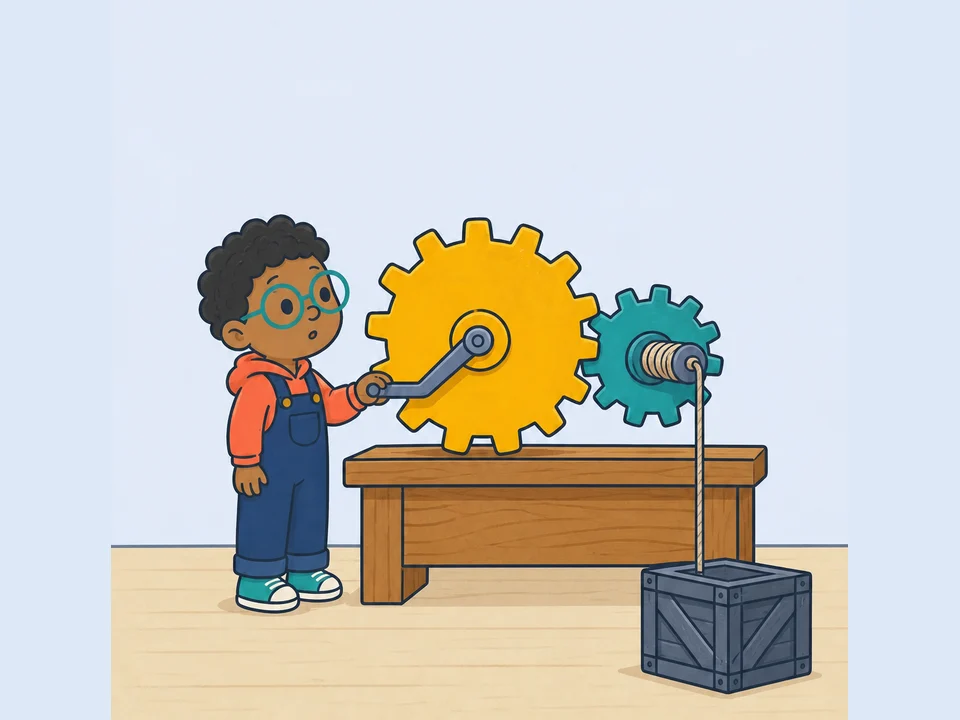
Can a tiny fast gear lift a heavy crate?
The little gear whirls when the crank turns. Its spool and rope lead to a crate resting on the floor. The fast spin is easy to see. What will happen when the crate pushes back?
One meeting point controls both wheels
Each amber tooth meets one teal tooth. Neither wheel can skip ahead at the contact.
Try a longer handle
Twice as far out gives twice the twist—and twice the hand travel. A rope pulls back too: a wider drum makes the same load resist with more twist.
Tap one tooth-step at a time
One amber tooth passes; one teal tooth passes. The counts stay matched.
Fewer teeth means more turns
The teeth share the same contact push. On a bigger output, that push acts farther from its axle: more twist, but fewer turns.
One crank turn makes three output turns
The rope drum turns with the output axle. The next test changes both the gear and its drum.
A bigger gear… and a wider drum
Same crank handles and crates. The right output gear has twice as many teeth. Its rope drum is also twice as wide.
Which needs less hand push to start the same crate?
Same crank and crate. Bigger gear AND wider drum.
Which machine needs less hand push to start lifting?
Increase the push together. Watch when each crate starts.