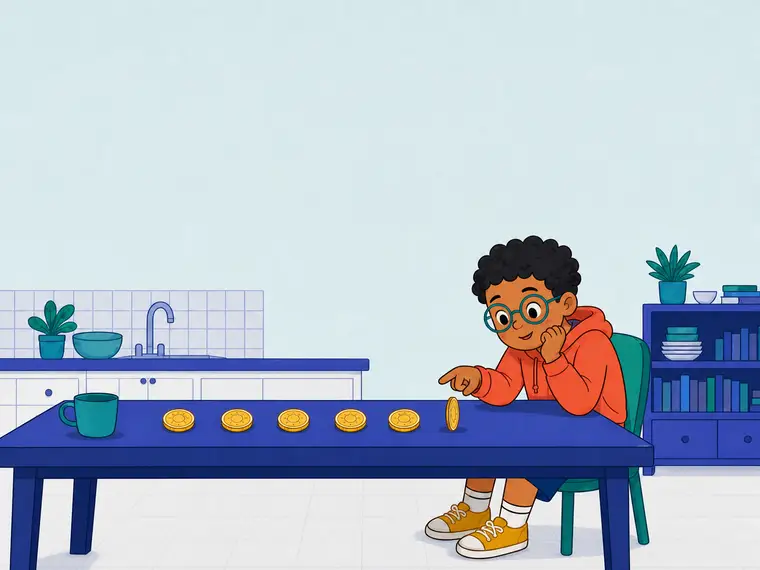
Can one streak tell you whether coin flips were random or typed by a person?
Did this make sense?
Your thumbs help us make it clearer.
Thanks! That helps us make it clearer.
After you watchCan one streak tell you whether coin flips were random or typed by a person?
The short answer
Streaks can be clues, but one run test cannot prove that a strip is random or fabricated. Fair independent coin flips can clump, while a person can deliberately type a long streak. Compare equal lengths and allow for chance.
Try this next
- Can you make your typed strip have the longer run? Type a run of eight heads, then add other flips. Predict the comparison before scanning a fresh equal-length simulated strip.
- Will a new simulated strip give the same result? Keep the typed strip fixed and repeat the scanner several times. Record which run is longer each time.
- What changes when the strip gets longer? Compare several short strips, then several longer ones. Keep the two sides equal in length in each test.
Now you — bend it
- What if Could a person deliberately make a very long run?The typed controls let you hold one outcome for as many taps as you choose.
- What if What happens if the simulated strip is longer than the typed one?More flips create more opportunities. Compare matched lengths before attributing a difference to origin.
Can you prove it?A long run alone cannot prove that a strip was randomly generated. — Type a long run yourself, then scan it. The scanner finds the run even though you chose every flip.
Design your own test:How will the distribution of longest runs change as both strips grow?
Explain it to a 6-year-old: A fair coin can repeat, and a person can type repeats too. A streak is a clue, not proof.
The whole story
How it works
A run is a stretch of identical outcomes. The scanner finds the longest run in your typed strip and in a new simulated fair-coin strip with the same number of flips. The simulation accepts its first sample; it never rerolls to force a long streak. Either strip can have the longer run, and ties can occur.
What people get wrong
Random does not mean evenly alternating. Long runs can occur in fair flips. But the reverse claim also fails: a long run does not prove that a person did not type the sequence.
The catch
A short statistic such as the longest run is easy to inspect, but it discards much of the sequence. Any classification rule can flag an honest sample or miss a fabricated one. Larger collections and several well-chosen tests can provide stronger evidence, still with uncertainty.
Questions kids ask
Can fair flips make six heads in a row?
Yes. Fair independent flips do not balance a previous run. The chance of at least one long run grows with the number of opportunities, so the strip length matters.
Does a long streak prove that a strip is random?
No. A person can type one intentionally. A run is a measurement, not a certificate of origin.
Why compare the same number of flips?
A longer strip has more chances to contain a long run. Matching lengths makes the comparison easier to interpret.
Can a fair coin produce a tidy alternating strip?
Yes. Every particular equal-length sequence has the same probability under the independent fair-coin model. Some classes of patterns are rarer than others, but one sample cannot establish how it was produced.
Talk about it
- What did the scanner actually measure, and what did it not prove?
- Could you type a strip that would fool a simple streak rule?
- Why should the two strips have the same number of flips?
For grown-ups
For independent fair Bernoulli trials, every specified sequence of a fixed length has equal probability. Longest-run distributions depend on sample size, so unequal-length comparisons confound the test. Expected longest runs grow on the order of log2(n). A statistical test provides evidence against a specified null model, not proof of fabrication; simulated samples must not be conditioned on achieving the preferred outcome.
Keep going
What else makes you wonder?
- If real coins clump into streaks, how does a casino or lottery prove their draws are honestly random?
- Could a computer's randomness be faked too, and how would you catch a machine instead of a person?
- Why does our brain feel so sure that 'spread out evenly' is what random should look like?