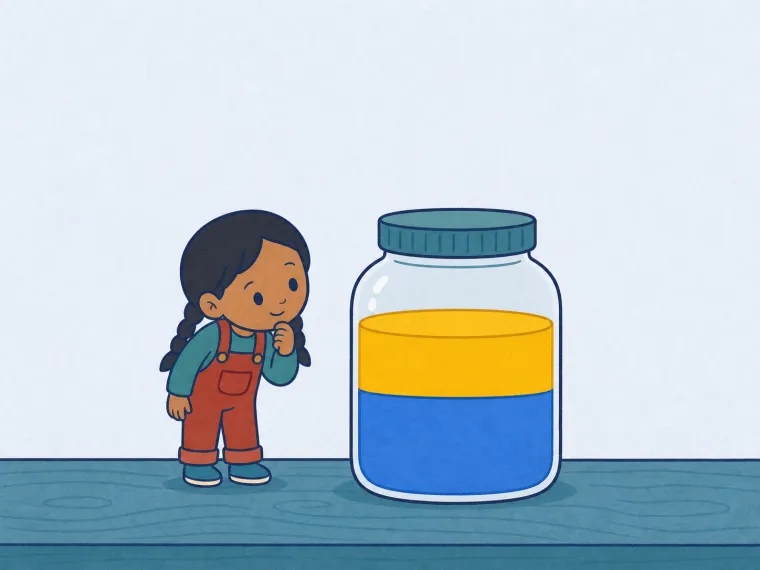
Will the same shaking affect equal-sized beads and a big-and-small mixture in the same way?
Did this make sense?
Your thumbs help us make it clearer.
Thanks! That helps us make it clearer.
After you watchWill the same shaking affect equal-sized beads and a big-and-small mixture in the same way?
The short answer
Shaking can create openings that small grains enter more easily than larger grains. Under some conditions this produces size segregation, with smaller grains lower and larger grains higher.
Try this next
- Does every jolt make perfectly separate layers? Replay the four jolts. Look for overlap between colors and compare their average heights.
- Why keep an equal-sized mixture beside the other jar? Compare the two jars after the same number of jolts. Explain which property the comparison tests.
Now you — bend it
- What if What if you replay exactly the same starting conditions?Observe both jars after each jolt, then replay from the same starting mixture. Compare average positions rather than expecting perfectly pure layers.
Can you prove it?A matched comparison can test your prediction. — Observe both jars after each jolt, then replay from the same starting mixture. Compare average positions rather than expecting perfectly pure layers.
Design your own test:Choose a supported setting and predict its result before running it.
Explain it to a 6-year-old: Shaking can create openings that small grains enter more easily than larger grains. Under some conditions this produces size segregation, with smaller grains lower and larger grains higher.
The whole story
How it works
The early diagrams show grain sizes, openings and unsorted starting mixtures. Practice only jiggles the entire pile. After prediction, four identical modeled jolts allow size-dependent rearrangement. Equal-sized colors have no size-based preference. Seeded initial states and per-jar randomness make replays repeatable.
What people get wrong
The model encodes a size-sieving tendency and is not a calibrated contact simulation. Density, shape, friction, air flow and shaking conditions can change or reverse real segregation. Equal size alone does not guarantee that every real mixture stays mixed.
The catch
The model encodes a size-sieving tendency and is not a calibrated contact simulation. Density, shape, friction, air flow and shaking conditions can change or reverse real segregation. Equal size alone does not guarantee that every real mixture stays mixed.
Questions kids ask
Will the same shaking affect equal-sized beads and a big-and-small mixture in the same way?
Shaking can create openings that small grains enter more easily than larger grains. Under some conditions this produces size segregation, with smaller grains lower and larger grains higher.
What can I change in this experiment?
Neutral whole-pile shaking strength before prediction; four identical test jolts and replay afterward.
Does this model describe every real case?
The model encodes a size-sieving tendency and is not a calibrated contact simulation. Density, shape, friction, air flow and shaking conditions can change or reverse real segregation. Equal size alone does not guarantee that every real mixture stays mixed.
Talk about it
- Does repeated shaking keep the big-and-small mixture blended, or develop size layers?
- Which observation supports your explanation?
- What does this model leave out?
For grown-ups
The early diagrams show grain sizes, openings and unsorted starting mixtures. Practice only jiggles the entire pile. After prediction, four identical modeled jolts allow size-dependent rearrangement. Equal-sized colors have no size-based preference. Seeded initial states and per-jar randomness make replays repeatable. The model encodes a size-sieving tendency and is not a calibrated contact simulation. Density, shape, friction, air flow and shaking conditions can change or reverse real segregation. Equal size alone does not guarantee that every real mixture stays mixed.
Keep going
What else makes you wonder?
- What would you change for a new test?
- Which two things must stay the same for a fair comparison?