Why does sugar dissolve faster in warm water?
Did this make sense?
Your thumbs help us make it clearer.
Thanks! That helps us make it clearer.
After you watchWhy does sugar dissolve faster in warm water?
The short answer
Sugar generally dissolves faster in warmer water under otherwise matching conditions. Temperature affects molecular motion and the rate of dissolution. Faster dissolution is distinct from the maximum amount that can dissolve.
Try this next
- What happens if we add much more sugar? Make a prediction and explain what you would keep the same in a fair comparison.
Now you — bend it
- What if What if you stop racing the SPEED and start asking about the AMOUNT — keep adding sugar to a hot cup and a cold cup until each one refuses to take any more. Which cup ends up holding more dissolved sugar at its limit?Speed (how fast it clears) and solubility (how much can ever dissolve) are two different knobs — predict which way the limit tips for sugar before you saturate each cup and look at the leftover pile.
- What if What if the thing dissolving is the fizz in soda instead of sugar — warm one bottle, chill another, and watch which goes flat faster. Does heat speed THIS dissolving up too, or fight it?Gas in water plays by an opposite rule from a solid like sugar — predict whether warming pulls the CO₂ in or drives it out before you uncap both bottles.
- What if What if heat and stirring aren't really the same trick? Stir a still cup hard without changing its temperature, then heat a cup without touching it. Predict which one a thermometer would call 'hotter' and why only one of them actually speeds up every bump.Stirring sweeps the sugar-soaked water away from the grain so fresh water keeps arriving; heat makes the molecules themselves move faster everywhere at once — predict which lever helps even deep inside a still part of the cup the spoon never reaches.
Can you prove it?Heat speeds dissolving by making the water molecules move faster and collide harder — it is not melting the sugar, and the temperature effect is large, often roughly doubling the rate for each ~10 °C of warming. — Drop one identical sugar cube into ice water (~5 °C), one into room-temperature water (~25 °C), and one into hot water (~45 °C), all unstirred, and time each to fully clear. If it were melting you'd see no dissolving until near sugar's ~186 °C melting point, but it clears in all three — and the times shrink steeply, roughly halving every ~10 °C step, which is the fingerprint of faster collisions, not melting.
Design your own test:Before you run it, predict whether doubling the temperature from cold to lukewarm cuts the clearing time roughly in half — or whether the speed-up is even steeper than that, since hotter molecules hit both more often AND harder.
Explain it to a 6-year-old: Hot water's tiny pieces are zooming and bumping the sugar super hard, so they knock it apart way faster than the slow, sleepy pieces in cold water.
The whole story
How it works
Water attracts whole sucrose molecules and separates them from the crystal. Warming changes molecular motion and speeds the process under matching conditions. If the added sugar is below the solubility limit in both cups, both can eventually dissolve it all.
What people get wrong
A faster-clearing cup does not necessarily contain more sugar at the end. There is no universal winner between unstirred hot water and hard-stirred cold water without specifying conditions.
The catch
Temperature, stirring, crystal size and amount of water all matter. Warm water can dissolve more sugar at saturation too, but that is a different measurement from how soon a small spoonful clears.
Questions kids ask
Why does sugar dissolve faster in warm water?
Sugar generally dissolves faster in warmer water under otherwise matching conditions. Temperature affects molecular motion and the rate of dissolution. Faster dissolution is distinct from the maximum amount that can dissolve.
What does the experiment compare?
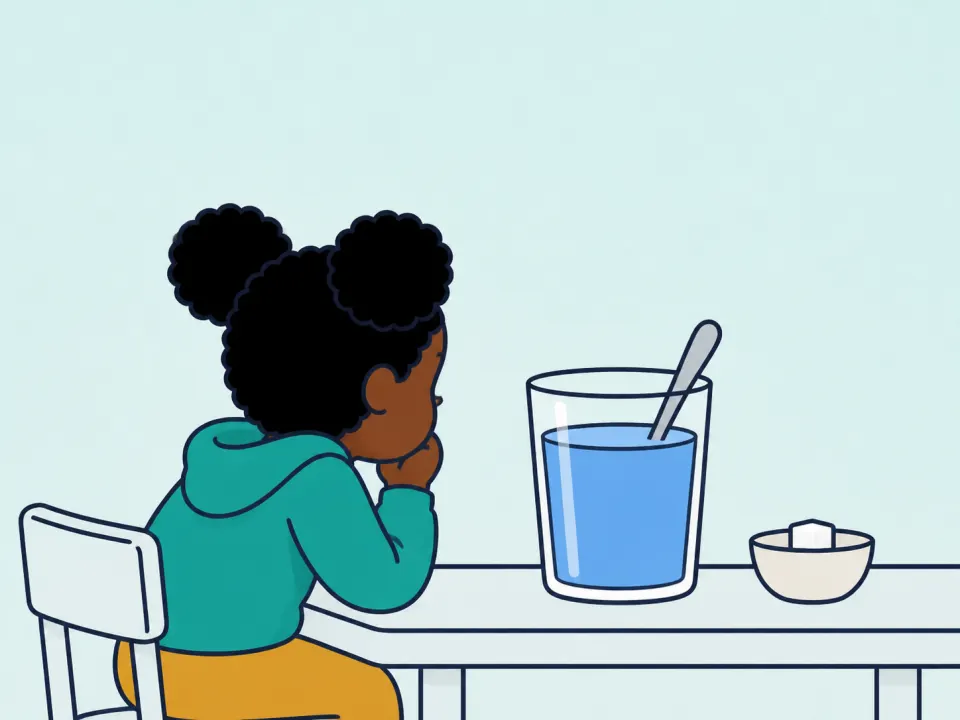
Predict whether equal small spoonfuls of sugar ultimately dissolve in both warm and cool water, with equal water amounts and stirring; watch the warm cup clear first and the cool cup catch up.
What is this model leaving out?
Temperature, stirring, crystal size and amount of water all matter. Warm water can dissolve more sugar at saturation too, but that is a different measurement from how soon a small spoonful clears.
Talk about it
- Same small spoonful and enough water in both cups: after plenty of time, does only the warm cup clear, or do both?
- What changed in the pictures that supports your idea?
- What happens if we add much more sugar?
For grown-ups
Dissolution rate and equilibrium solubility are distinct. Sucrose solubility increases with temperature, while transport and interfacial processes determine rate. The animation is qualitative and claims no measured times or universal competition between heating and stirring.
Keep going
What else makes you wonder?
- What happens if we add much more sugar?
- What would you change in the experiment next?