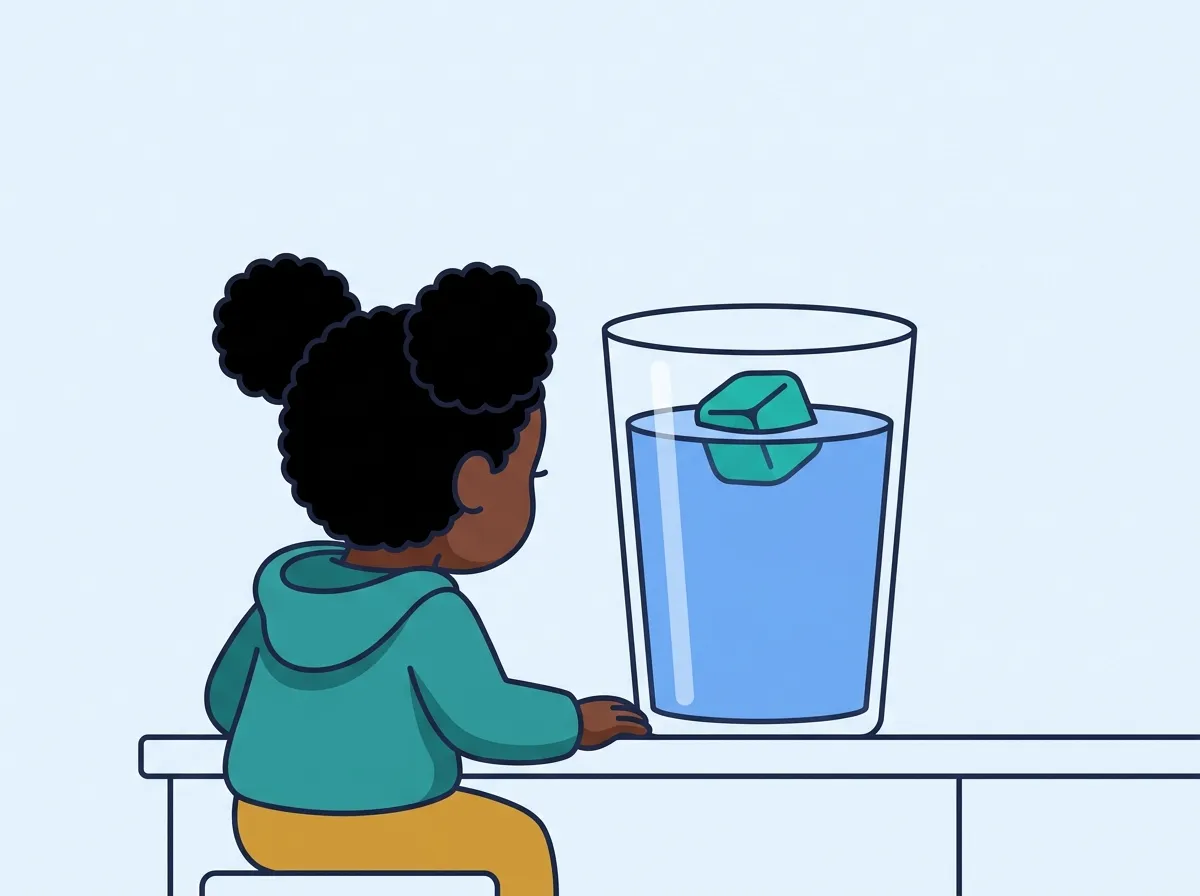
Why does sugar vanish in water but sand just sits there?
Did this make sense?
Your thumbs help us make it clearer.
Thanks! That helps us make it clearer.
After you watchWhy does sugar vanish in water but sand just sits there?
The short answer
Water can separate whole sucrose molecules from a sugar crystal and surround them. They remain in the solution even when invisible. Quartz sand has a strong silicon–oxygen network that ordinary water does not readily dissolve.
Try this next
- What could separate the sugar from its water? Make a prediction and explain what you would keep the same in a fair comparison.
The whole story
How it works
Sugar molecules have polar groups that interact with water. Their atoms stay bonded as the molecules separate from the crystal. Sand grains can be wetted by water without dissolving. Paper filters hold large grains while dissolved molecules pass through with water.
What people get wrong
Dissolving neither destroys sugar nor breaks sucrose into its atoms. Quartz is not simply a nonpolar material that ignores water; its strong network resists dissolution.
The catch
Paper filtration can separate sand from water but cannot recover dissolved sugar. Evaporation can leave sugar behind; no tasting is needed to test a lab mixture.
Questions kids ask
Why does sugar vanish in water but sand just sits there?
Water can separate whole sucrose molecules from a sugar crystal and surround them. They remain in the solution even when invisible. Quartz sand has a strong silicon–oxygen network that ordinary water does not readily dissolve.
What does the experiment compare?
Predict whether identical paper filters hold back dissolved sugar and suspended quartz sand, then pour both and follow molecules versus grains through the holes.
What is this model leaving out?
Paper filtration can separate sand from water but cannot recover dissolved sugar. Evaporation can leave sugar behind; no tasting is needed to test a lab mixture.
Talk about it
- Will a paper filter catch dissolved sugar, sand grains, both, or neither?
- What changed in the pictures that supports your idea?
- What could separate the sugar from its water?
For grown-ups
Sucrose dissolves as intact, hydrated molecules. Quartz has very low solubility in ordinary water because dissolving requires disrupting its extended Si–O network. Paper filtration separates suspended particles by size, rather than removing dissolved molecules.
Keep going
What else makes you wonder?
- What could separate the sugar from its water?
- What would you change in the experiment next?