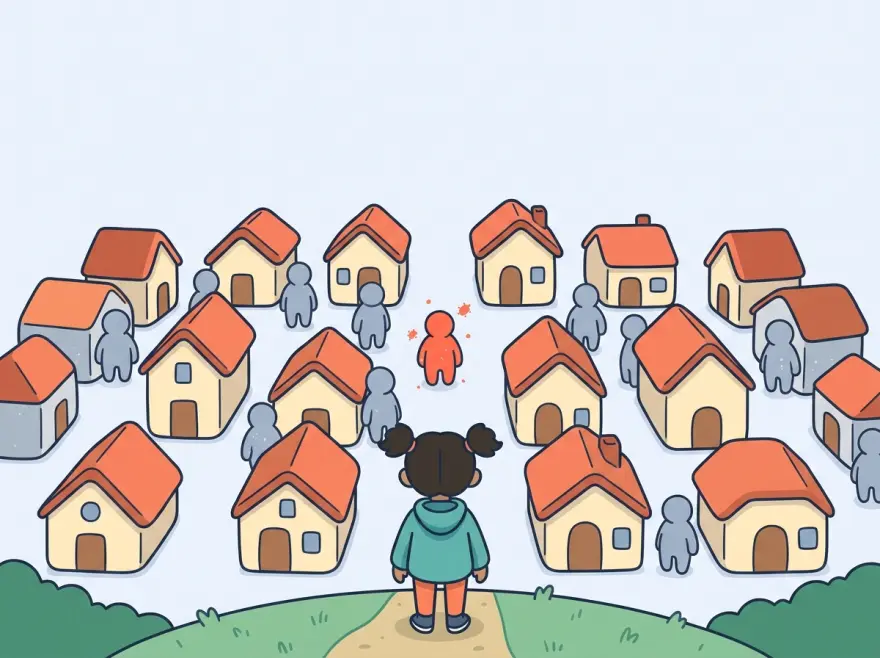
Why do gossip, viral videos, and rumors blow up fast at first, then suddenly stall?
Did this make sense?
Your thumbs help us make it clearer.
Thanks! That helps us make it clearer.
After you watchWhy do gossip, viral videos, and rumors blow up fast at first, then suddenly stall?
The short answer
Spread needs active tellers as well as fresh listeners. A large number of people who know a rumor does not mean many are still spreading it. In the fresh hidden case, only one person is active and each active teller makes one contact attempt, so a round can add at most one listener.
Try this next
- What changes when the active teller tries two contacts? Predict whether one round can now create two new tellers, then increase attempts and replay.
- Why does the one-contact chain stop? Follow the last active teller until the contact reaches someone who already knows.
- Do 63 knowers mean 63 tellers? Count outlined active dots and compare with all coral dots.
Now you — bend it
- What if What if each active teller attempts two contacts?The lab permits branching, but both contacts may not be fresh.
- What if What if the last active teller reaches someone who already knows?Who is left to tell in the next round?
- What if Would two starting active tellers obey the same one-new-listener bound?Apply the per-teller limit to both people. This is a reasoning extension, not another lab setting.
Can you prove it?At the one-attempt setting, this scenario adds at most one new listener per round. — Step through the fresh run and compare the active-teller count and each round’s increase. Then explain why the rule preserves at most one active teller.
Design your own test:Before you run it, draw where you think the curve's flat top will land for your town size — then check how close the stall comes.
Explain it to a 6-year-old: A secret spreads super fast while lots of people haven't heard it, then stops when almost everyone already knows.
The whole story
How it works
The model distinguishes fresh listeners, active tellers, and people who know but no longer repeat the rumor. The hidden case begins with 62 quiet knowers and one active teller. At one attempt per teller, there can be at most one new active teller next round. Normal and calm views use the same seeded contact sequence and snapshots. The graph counts only listeners added after the starting 63.
What people get wrong
The total number who know a rumor is not the number still spreading it. A large pool of quiet knowers cannot produce new tellers. The fresh hidden case can grow by at most one listener per round at its initial setting.
The catch
A larger attempt count can produce branching, but repeated contacts and inactive tellers can stop the spread. Individual runs may stall early; not every rumor follows a smooth S-curve or reaches everyone.
Questions kids ask
Why do 63 starting knowers not create 63 tellers?
The scenario says 62 have stopped repeating it. Only the remaining active person makes a contact.
Why can a one-attempt round add at most one listener?
One active teller can contact only one person. That can create zero or one new active teller for the next round.
Why does this chain stop?
The last active teller contacts someone who already knows. No fresh listener becomes the next teller.
Talk about it
- Guess first: if a rumor doubles every recess, how many recesses until the whole grade knows?
- Why do you think a rumor stops spreading — because people get bored, or because something else runs out?
- If you wanted a secret to reach everyone fast, who would you tell first and why?
For grown-ups
The finite population model has uninformed, active, and inactive states. Active tellers each make a fixed number of contact attempts and then become inactive. New listeners become active in the next round. Collisions can end a run while uninformed people remain. Normal and calm views use the same seeded sequence; not every run has logistic growth or reaches most of the population.
Keep going
What else makes you wonder?
- If nobody ever un-knows a rumor, what would it take to make a fresh ear appear again — new kids moving to town?
- Some rumors come back months later even though everyone already heard them. What changed to give them new fresh ears?
- If you wanted a rumor to reach the whole town, would you rather tell a few people who each tell tons, or tons of people who each tell a few?