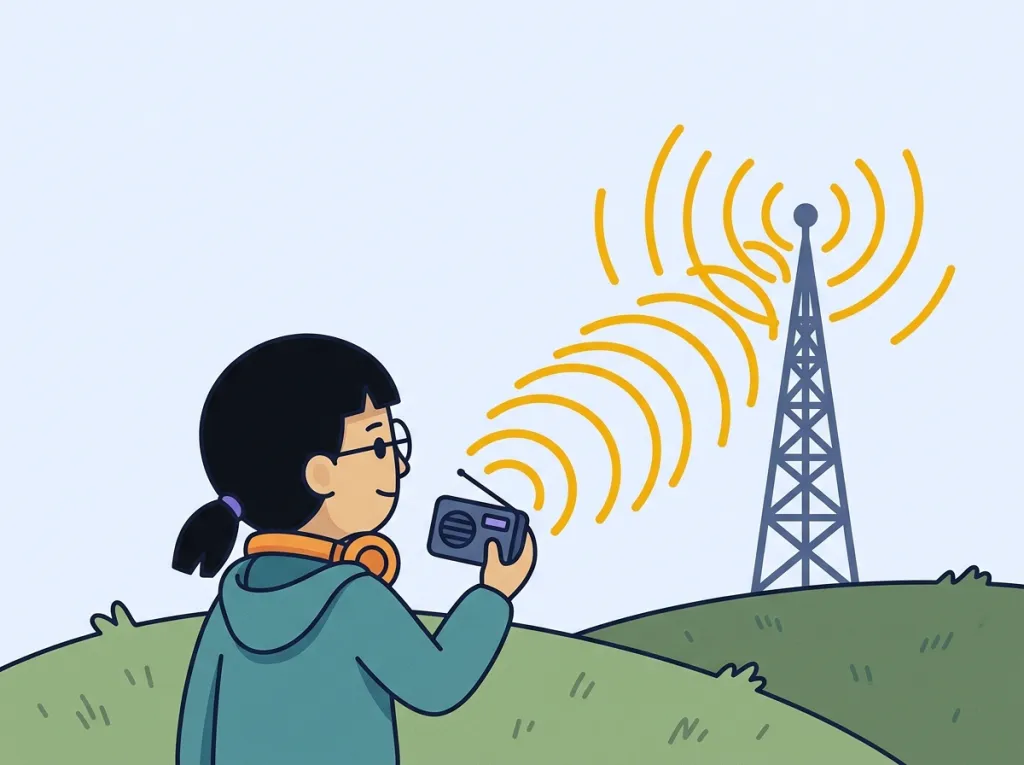
Why can't you see around a corner, but you can hear around one?
Did this make sense?
Your thumbs help us make it clearer.
Thanks! That helps us make it clearer.
After you watchWhy can't you see around a corner, but you can hear around one?
The short answer
At fixed wavelength, narrowing an opening broadens the main diffraction lobe. The total transmitted sound can still decrease. Light diffracts too, but its small wavelength makes diffraction around everyday doorways much less noticeable.
Try this next
- What if you made the gap in the wall much wider than the wave? Widen the opening in the experiment and predict first: does the big sound wave still fan out as much, or does it start to march straight through like the light beam?
- What if a low note and a high note both came around the same corner? At home, play a deep bass and a high whistle from another room and guess which one you hear more clearly around the corner before you listen.
The whole story
How it works
The hidden model draws the first minimum at sin(theta)=lambda/d. Opening width d ranges from 4 lambda to 1.2 lambda; the displayed half-angle therefore grows from about 14 to 56 degrees. It is a far-field single-slit analogy. Weak side lobes, reflections and actual room acoustics are omitted.
What people get wrong
A narrow opening does not necessarily make all sounds louder. The model shows spreading angle, not total transmitted power or the actual audibility threshold.
The catch
Big waves and tiny waves each give up something. Sound's big waves bend around corners, but being so wide they blur fine detail, so you can tell that a voice is there without seeing the exact shape it came from. Light's tiny waves keep razor-sharp edges, which is how your eyes resolve small details and read fine print, but the price is hard shadows: tiny waves do not bend around walls, so there is no seeing around a corner.
Questions kids ask
If the wavelength stays fixed and the opening narrows, what happens to the main sound fan?
At fixed wavelength, narrowing an opening broadens the main diffraction lobe. The total transmitted sound can still decrease. Light diffracts too, but its small wavelength makes diffraction around everyday doorways much less noticeable.
Talk about it
- If the wavelength stays fixed and the opening narrows, what happens to the main sound fan?
- What stayed the same while you changed the control?
- Which part of the picture supports your prediction or challenges it?
For grown-ups
The hidden model draws the first minimum at sin(theta)=lambda/d. Opening width d ranges from 4 lambda to 1.2 lambda; the displayed half-angle therefore grows from about 14 to 56 degrees. It is a far-field single-slit analogy. Weak side lobes, reflections and actual room acoustics are omitted.
Keep going
What else makes you wonder?
- If sound waves wrap around walls, how does anyone ever get a quiet, private room?
- Bats and dolphins find things using sound. Do they use big waves or tiny ones to catch the smallest details?
- Could you build a shape that catches a sound and sends it only one way, even though sound likes to spread?