Is it harder to START a box sliding or to KEEP it sliding?
Did this make sense?
Your thumbs help us make it clearer.
Thanks! That helps us make it clearer.
See it another way
Why Is Static Friction Greater Than Kinetic Friction?
Zoom into tiny surface bumps and bonds to see why breaking loose takes more force than keeping a slide going.
Requires internet. You’re leaving Clickory in a new tab; YouTube may show ads or recommendations.
Keep going
What else makes you wonder?
Does every surface grip a still object harder than a sliding one, or are some floors the same either way?
Use the story’s model. Change one thing, predict first, then imagine a matched test.
Where else do you feel something pop loose and then go easy — a stuck jar lid, a squeaky door, a zipper?
Use the story’s model. Change one thing, predict first, then imagine a matched test.
If you could make the static grip and the kinetic grip exactly equal, would anything ever lurch?
Use the story’s model. Change one thing, predict first, then imagine a matched test.
More to explore

After you watchIs it harder to START a box sliding or to KEEP it sliding?
The short answer
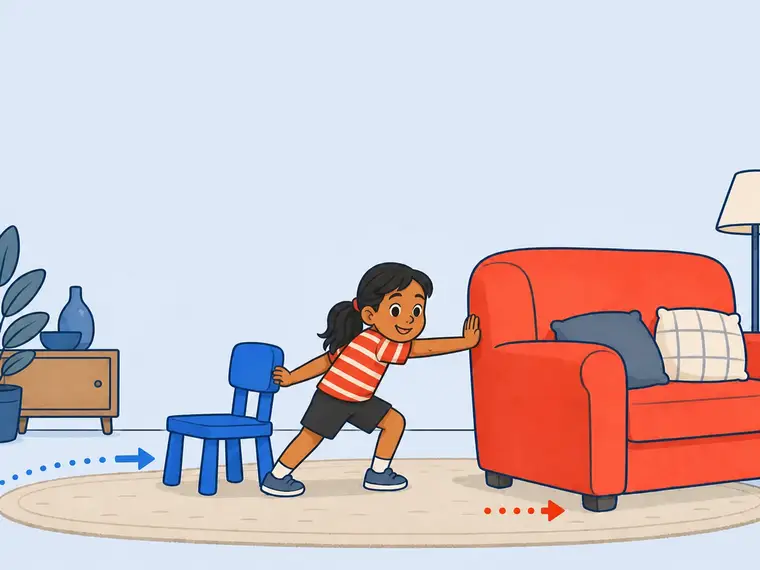
Starting a box moving is harder than keeping it sliding because a still object grips the floor more strongly than a moving one. The stronger grip on a still object is called static friction, and the weaker grip on a sliding object is called kinetic friction. You have to out-pull the strong static grip to break the box free, and then a smaller pull is enough to keep it gliding.
Try this next
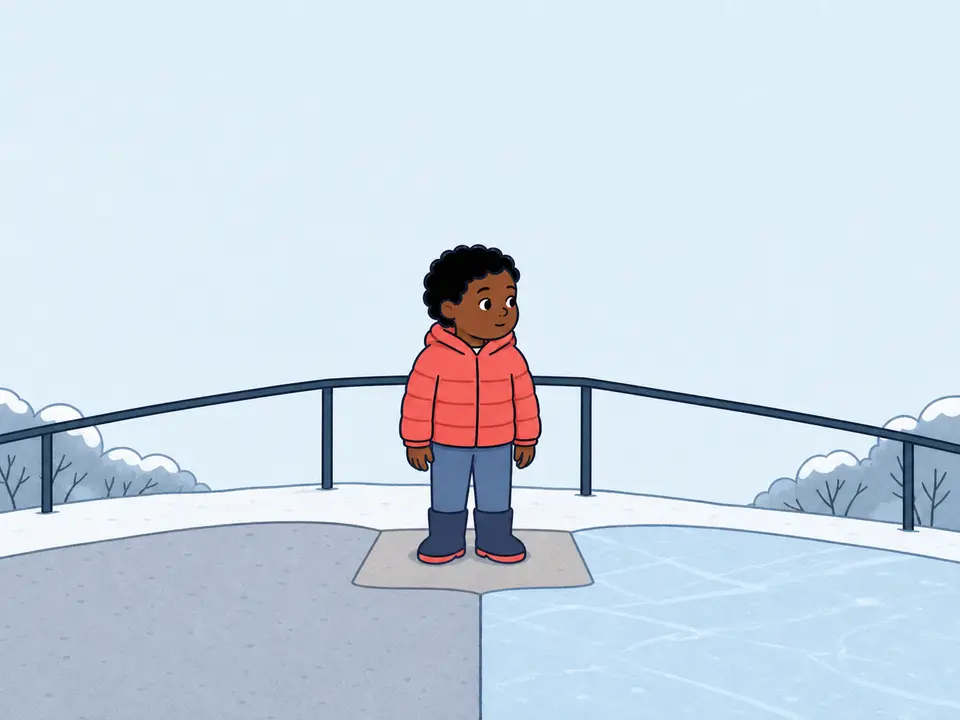
- What if the floor were super slippery, like ice? Imagine the experiment on ice and predict first: does the box still pop loose with a lurch, or barely grip at all? Then push a real object across a smooth floor and a rough rug and feel which one snaps free harder.
- What if you push slowly instead of yanking hard? Predict whether a slow, gentle build-up still ends in a sudden lurch. Then lean on a heavy chair and add force little by little, and watch for the exact moment the static grip lets go.
- What if the box were twice as heavy? Predict before you test: does extra weight make the starting pull and the sliding pull both bigger, or only one of them? Then drag a backpack empty, then full, and compare the first heave to the easy glide.
Now you — bend it
- What if Thought experiment: keep the same box on the same level floor, and change only the pull while it is still at rest.The resting grip can match a range of pulls up to its limit. Predict whether each new pull stays below that limit before checking the practice meter.
- What if Thought experiment: compare two boxes already sliding on the same floor, each with a different applied pull.Compare each pull with the sliding drag. A forward force balance changes speed; do not compare it with the limit for a box at rest.
- What if Thought experiment: a different surface has nearly equal maximum resting grip and sliding drag. What changes about the lurch at release?Keep the box and applied pull fixed. Compare the net force just before and just after sliding begins; a smaller change gives a gentler change in acceleration.
Can you prove it?For the same box, acceleration after release depends on the applied pull minus the sliding drag. — Compare two applied pulls for the same moving box and same sliding drag. The larger net force produces the larger acceleration. If you also change the mass, compare net force divided by mass instead.
Design your own test:Choose a new pull below, equal to, or above the sliding drag. Predict how speed changes, and explain which force balance supports your prediction.
Explain it to a 6-year-old: The floor can grip a still box tightly. Once it slides, use the moving grip to work out how its speed will change.
The whole story
How it works
Friction is the floor resisting an object dragged across it. For the same two surfaces, the most the floor can grip a still object (maximum static friction) is usually larger than the steady grip on a moving object (kinetic friction). While the box is still, the floor pushes back exactly as hard as you pull, so it stays put until your pull beats the static limit. The instant it breaks free, the resistance drops to the smaller kinetic amount, so the box lurches and then needs less force to keep sliding.
What people get wrong
Many people assume friction is one fixed amount, so pushing feels equally hard the whole time. In reality the grip changes the moment the object moves: the static grip on a still object is generally stronger than the kinetic grip on a moving one. That is why things feel glued down, pop loose, and then slide more easily, and it is why you can ease off your push a little once something is moving and it keeps going.
The catch
The strong static grip is useful because it holds things in place, so a parked car stays put and a book rests on a tilted desk without sliding off. The cost is that the first shove is the hardest part of moving anything. The weaker kinetic grip saves effort once something is moving, but it also means a sliding object grips the floor less, so a skidding car or a slipping shoe is harder to control than one that still has its static grip.
Questions kids ask
What are static friction and kinetic friction?
Static friction is the floor's grip on an object that is not moving yet, and it can grow to match your push up to a maximum. Kinetic friction is the floor's grip on an object that is already sliding. For the same surfaces, the maximum static grip is usually stronger than the kinetic grip, which is why starting takes more force than keeping going.
Why does a heavy box suddenly lurch when it finally moves?
While the box is still you build your pull up to beat the strong static grip. The instant it breaks free, the grip drops to the weaker kinetic amount, so your pull is now bigger than the resistance and the leftover force jerks the box forward before you can ease off.
If the grip is weaker while sliding, why does a moving thing still stop?
Kinetic friction is weaker than static friction, but it is not zero, so it keeps pulling backward on a sliding object and gradually slows it down. If you stop pushing, that drag wins and the object stops, and then the stronger static grip holds it still again.
Does this only happen because the box is heavy?
No. Weight makes both grips larger, but the key fact is that the static grip is stronger than the kinetic grip whatever the weight. Even a light object is usually a bit harder to start than to keep sliding for the same reason.
Talk about it
- Guess first: do you think it takes more force to START the box moving or to KEEP it moving? Why?
- What's something at home that feels glued down, then suddenly pops loose when you pull hard enough?
- Once something is sliding, why can you ease off your push a little and it still keeps going?
For grown-ups
For a given pair of surfaces the coefficient of static friction is typically greater than the coefficient of kinetic friction, so the force to initiate sliding (up to the static maximum, μ_s·N) exceeds the force to sustain it (μ_k·N). When motion begins the resisting force drops, so for a steady applied force the net force becomes positive and the object accelerates with a lurch. This static-over-kinetic gap drives stick-slip phenomena such as squeaky hinges, bowed violin strings, and even some earthquake mechanics, and it is why anti-lock braking keeps tires near the peak static grip rather than letting them fully skid into the lower kinetic regime.