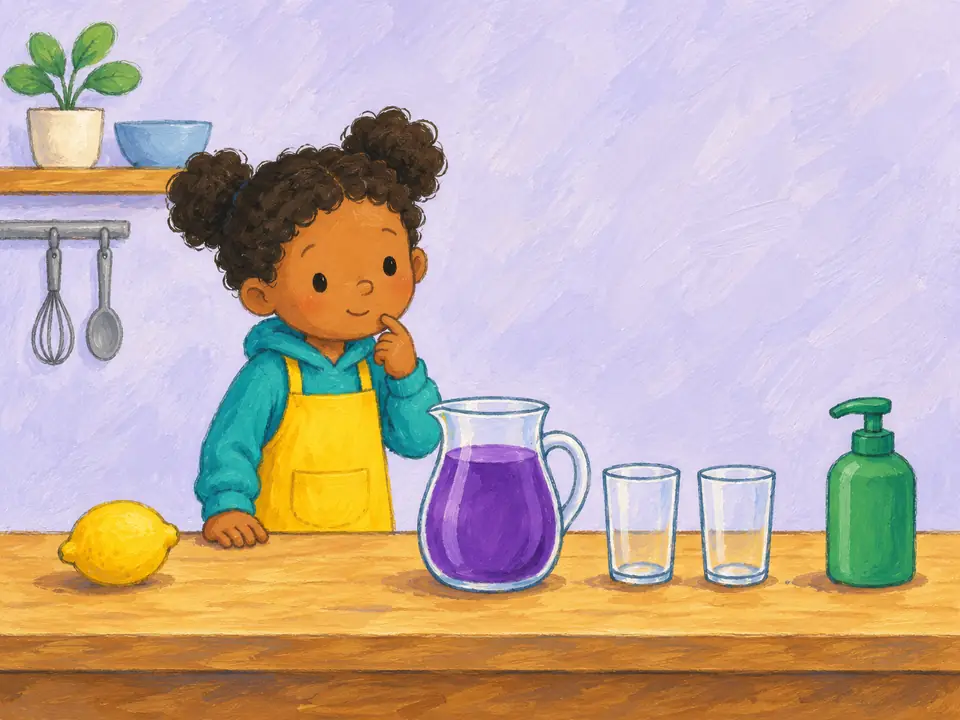
Where does the fizz come from—and can more baking soda always make more?
Did this make sense?
Your thumbs help us make it clearer.
Thanks! That helps us make it clearer.
After you watchWhere does the fizz come from—and can more baking soda always make more?
The short answer
Acid reacts with bicarbonate to make water and carbon dioxide. The carbon dioxide forms the fizz; it was not stored inside the powder as ready-made gas. The reaction stops when a reacting partner runs out.
Try this next
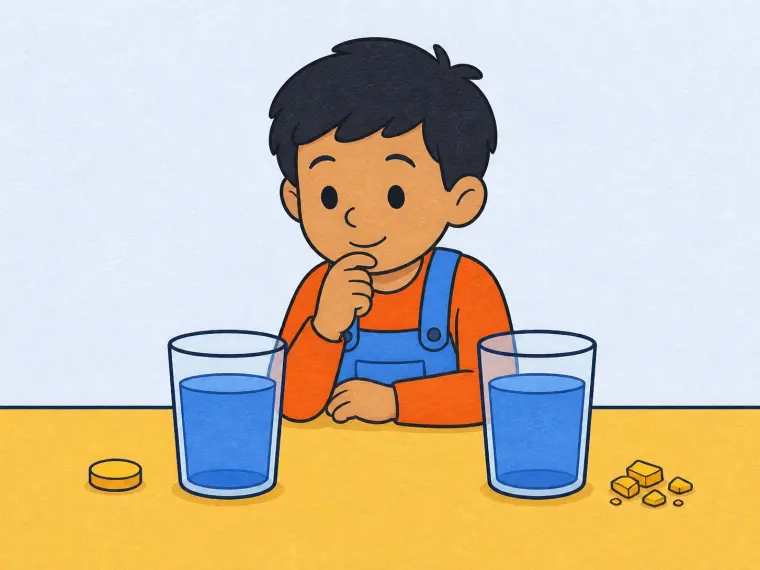
- What if both reacting amounts doubled? Draw twice as many gold and blue tokens. Predict the gas amount, then pair them one at a time.
- What if you added more acid after the model stopped? Draw two new acid tokens beside the leftover bicarbonate. Predict which new pairs can react.
The whole story
How it works
An acid supplies hydrogen ions that react with bicarbonate. In our exact token model, each gold acid token reacts with one blue bicarbonate token to make one equal model amount of carbon dioxide. Both cups receive four acid tokens, so each makes four gas units even though cup B starts with extra bicarbonate.
What people get wrong
More baking soda does not always mean more gas. Extra bicarbonate cannot keep this acid-bicarbonate reaction going once the available acid has been used. Foam height is also not a direct measurement of gas amount.
The catch
Real foam depends on bubble size, liquid, mixing, and how long bubbles last. Carbonated water already contains dissolved carbon dioxide and carbonic acid, so it is not a plain-water control.
Questions kids ask
Was the gas trapped inside the baking soda?
No. Bicarbonate reacts with acid to form new substances, including carbon dioxide. The atoms rearrange; a ready-made gas bubble was not hiding inside each grain.
Why does plain water behave differently?
Plain water can dissolve baking soda without supplying the added acid needed for the large carbon-dioxide-producing reaction shown here. Dissolving and making a new gas are different processes.
Is fizzy water the same as plain water?
No. Carbonated water contains dissolved carbon dioxide, and some reacts with water to form carbonic acid. Existing gas can escape too, complicating a fizz comparison.
Does more powder always produce more gas?
No. The amount of every reacting partner matters. In the model, extra bicarbonate remains when the acid is used up, and the two cups make the same gas amount.
Talk about it
- Which partner ran out in each cup?
- What evidence separates gas made from bicarbonate left over?
- Why would counting foam bubbles be a different test?
For grown-ups
Net reaction: H⁺ + HCO₃⁻ → H₂O + CO₂. Tokens represent equal chemical amounts, not spoonfuls or individual grains. The model demonstrates limiting reactants; available acid capacity limits gas yield. Real lemon juice is a weak, multi-proton acid whose reacting capacity must be measured. Sodium ions remain in solution.
Keep going
What else makes you wonder?
- What could make the leftover bicarbonate react after the first fizz stops?
- Can two reactions make the same gas amount at different speeds?
- How could you measure gas without trusting the foam height?