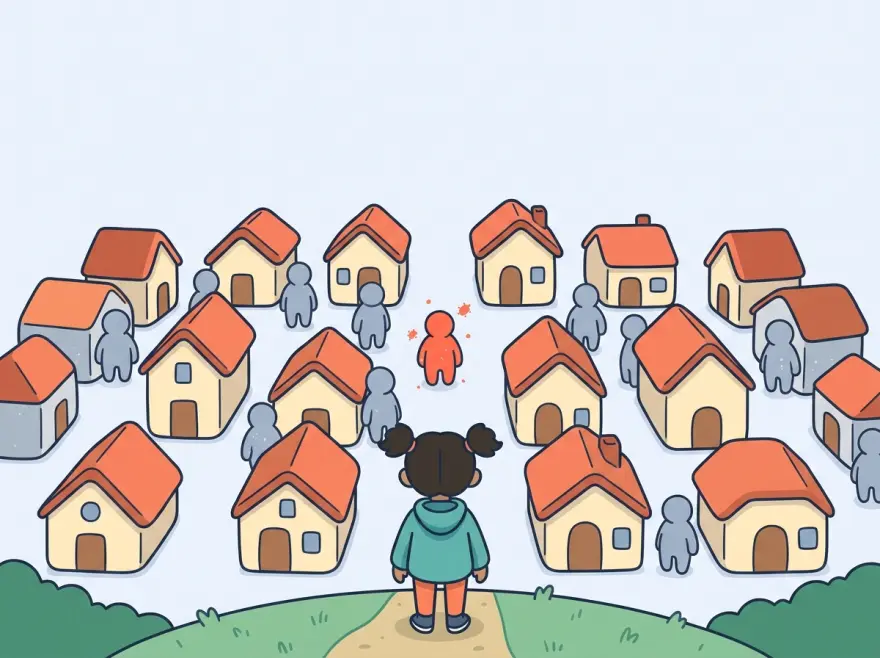
Does the germ that makes you sicker always spread less?
Did this make sense?
Your thumbs help us make it clearer.
Thanks! That helps us make it clearer.
After you watchDoes the germ that makes you sicker always spread less?
The short answer
How sick an infection makes someone does not by itself tell us how widely it spreads. Infectious timing, contacts, immunity, route, and chance all matter.
Try this next
- Which contact round makes the largest difference? Replay the three rounds and compare the A and B totals after each one.
- What if most meetings happened in the last round? Thought experiment: swap the 5 and 1 contact counts. Keep both infectious windows fixed and work out the new totals. The buttons do not change the schedule.
Now you — bend it
- What if Thought experiment: exchange the first and last contact counts.Recalculate each window with contacts 1, 3, 5. The screen keeps its original schedule.
- What if Thought experiment: only half of infectious contacts transmit.The current screen makes every infectious contact transmit. How would adding chance change the certainty of its totals?
Can you prove it?Severity alone cannot decide the contact test. — Use the three-round replay to count each window. Compare the observed result with the earlier mobile-contact assumption.
Design your own test:Pick how fast your germ floors people, then predict: does flooring them sooner help it reach more people or fewer?
Explain it to a 6-year-old: In our pretend town, more meetings give a germ more chances to spread. Real germs have many different ways to travel.
The whole story
How it works
First explore a toy town where becoming too ill to walk removes contacts. Then test a different case: A can transmit in rounds 1 and 2, before serious illness later; mild B can transmit in rounds 2 and 3. The three rounds have 5, 3, and 1 distinct contacts. Count completed contacts within each infectious window. Every infectious contact transmits in this model, and later chains are omitted.
What people get wrong
Evolution does not promise that germs become milder. Harm and transmission can rise, fall, or stay similar; a severely ill person can still transmit an infection. This two-version town is not a forecast of disease evolution.
The catch
These simple models isolate contact timing. Real infections vary in how likely each contact is to transmit, and can spread before symptoms, from someone in bed, or through other routes. The models are not disease forecasts.
Questions kids ask
Do germs always become milder?
Evolution does not promise that germs become milder. Harm and transmission can rise, fall, or stay similar; a severely ill person can still transmit an infection. This two-version town is not a forecast of disease evolution.
What decides the result of the timing test?
Count the contacts during each infectious window. A overlaps the two earlier rounds, while B overlaps the two later rounds. The number of contacts, rather than the illness label alone, decides this simplified result.
Can a severe infection spread widely?
Yes. Severe illness does not guarantee low transmission. Timing, infectiousness, route, and host immunity all matter.
Talk about it
- What did you count to make your prediction?
- How did the new timing rule differ from the walking-dot town?
- Which real-world factors are missing from the contact model?
For grown-ups
The gate counts only first onward infections under specified windows and a fixed contact schedule. A makes 5 + 3 = 8 and B makes 3 + 1 = 4. This counterexample shows why severity alone cannot determine transmission success; it is not a quantitative model of pathogen evolution.
Keep going
What else makes you wonder?
- How would the race change if both versions stayed mobile for the same time?
- Could transmission before symptoms change the result?