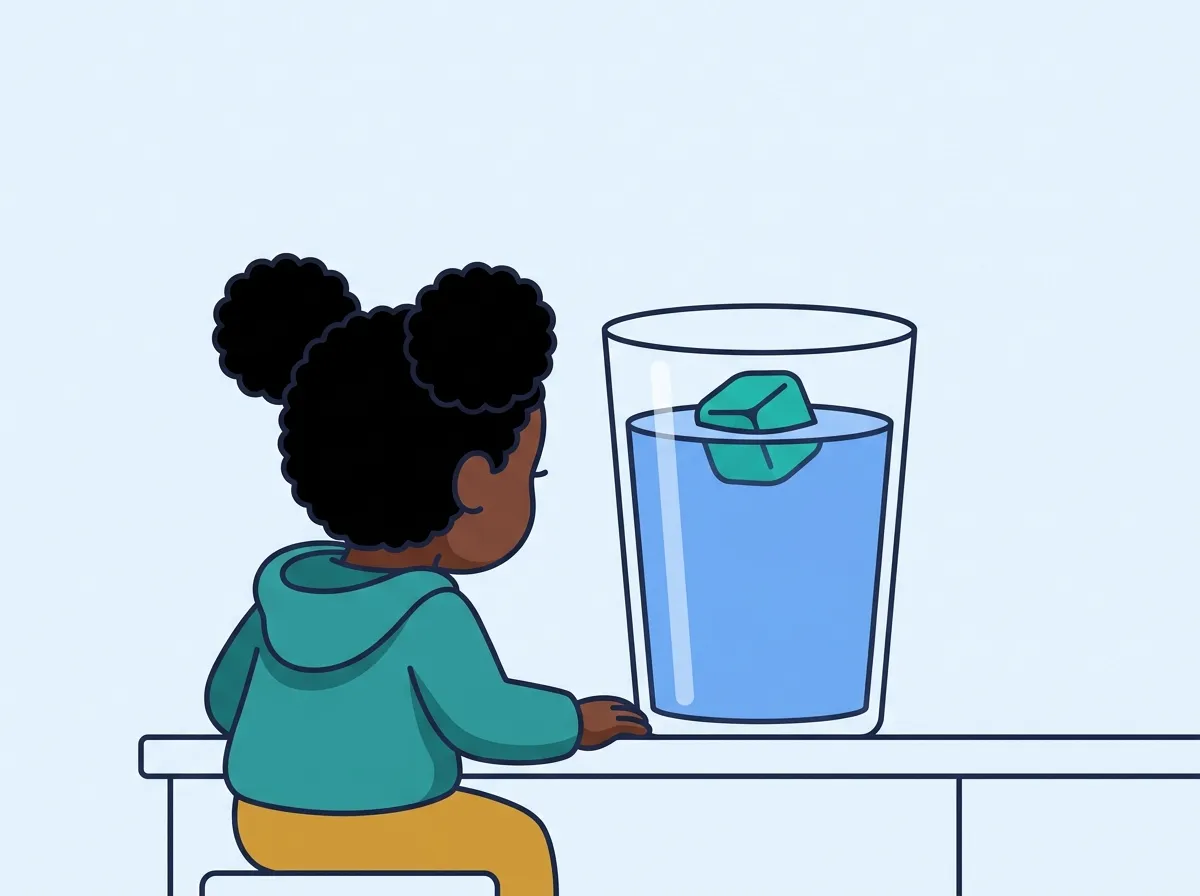
Why does freezer ice turn out cloudy but fancy ice is crystal clear?
Did this make sense?
Your thumbs help us make it clearer.
Thanks! That helps us make it clearer.
After you watchWhy does freezer ice turn out cloudy but fancy ice is crystal clear?
The short answer
Cloudy ice often contains tiny trapped bubbles. Growing ice tends to reject dissolved gas into the remaining water. Directional freezing can leave a clearer region, but the gas-rich last liquid still needs somewhere to go.
Try this next
- Where would the cloudy part move if the freezing direction changed? Make a prediction and explain what you would keep the same in a fair comparison.
The whole story
How it works
Both modeled cups freeze downward. One stops before the bottom freezes and removes the remaining liquid and its gas. The other keeps that liquid and freezes it, allowing bubbles to become trapped near the bottom.
What people get wrong
Slow top-down freezing does not make gas disappear through a solid cup bottom. If everything freezes, the final region can still become cloudy. Stirring also does not reliably remove all dissolved air.
The catch
Clear-ice methods can take time and leave water or cloudy ice to discard. Minerals, cracks, freezing rates and temperature gradients can also affect transparency.
Questions kids ask
Why does freezer ice turn out cloudy but fancy ice is crystal clear?
Cloudy ice often contains tiny trapped bubbles. Growing ice tends to reject dissolved gas into the remaining water. Directional freezing can leave a clearer region, but the gas-rich last liquid still needs somewhere to go.
What does the experiment compare?
Predict whether top-down freezing stays clear if the final gas-rich water is also frozen, then compare stopping and removing the last liquid with freezing the whole cup.
What is this model leaving out?
Clear-ice methods can take time and leave water or cloudy ice to discard. Minerals, cracks, freezing rates and temperature gradients can also affect transparency.
Talk about it
- Both cups freeze from the top down. If one keeps freezing its final gas-rich water, will its bottom stay clear or trap bubbles?
- What changed in the pictures that supports your idea?
- Where would the cloudy part move if the freezing direction changed?
For grown-ups
A growing ice front rejects much dissolved gas into the liquid. Local supersaturation can nucleate bubbles that become trapped. Directional freezing controls where the last gas-rich region ends up; it does not guarantee a bubble-free entire block.
Keep going
What else makes you wonder?
- Where would the cloudy part move if the freezing direction changed?
- What would you change in the experiment next?